


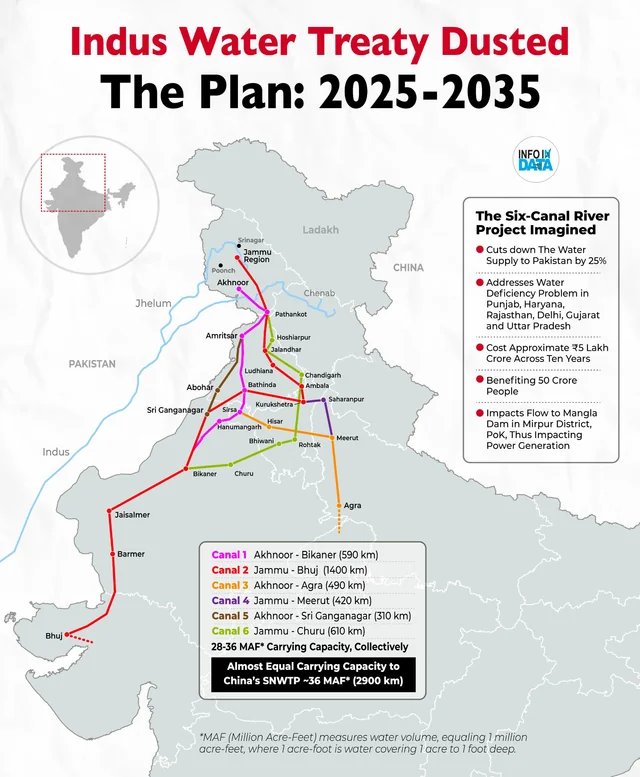


The phrase /pakistan-in-acute-danger-indus-changes-hit-agriculture is no longer just a political slogan — it’s an agricultural and environmental warning. Experts say even minor changes by India in the Indus River’s flow could devastate Pakistan’s farming system, trigger food shortages, and fuel economic instability.
As India recalibrates its water policy, Pakistan’s heavy reliance on the Indus Basin makes it uniquely vulnerable to even small upstream adjustments.
1. Why Pakistan in Acute Danger Is No Exaggeration
Nearly 80% of Pakistan’s agriculture depends on the Indus River system — one of the most extensive irrigation networks in the world. However, India’s recent suspension of the Indus Waters Treaty has put that lifeline in question.
Pakistan’s fragile water storage capacity (barely 30 days’ worth of flow) means that even temporary disruptions could cause massive agricultural losses. The Food and Agriculture Organization (FAO) has repeatedly warned that Pakistan is among the world’s top 10 water-stressed countries.
“If the Indus flow is altered, our farmlands will wither before the harvest,” says Dr. Khalid Rana, a water policy expert from Lahore University.


2. How Small Indian Changes Could Hit Pakistan Hard
India’s upstream control gives it the ability to alter the timing and quantity of Indus flows, especially during crucial planting seasons.
According to India Today, these include:
- Temporary reservoir flushing that disturbs downstream irrigation.
- Short-term water retention for hydropower operations.
- Seasonal timing shifts that delay sowing in Pakistan’s Punjab and Sindh provinces.


The Pakistan in Acute Danger scenario directly impacts its economic foundation.
- Agriculture contributes 20% to GDP and employs nearly 40% of the workforce.
- Over 90% of crops depend on reliable Indus irrigation.
The World Bank’s Indus Basin study highlights that even a 10% reduction in Indus flow could reduce crop yields by 30% in the short term.
Farmers in southern Punjab have already reported water shortages, forcing many to abandon cultivation or migrate to cities for work.
4. Pakistan in Acute Danger from Weak Infrastructure
Pakistan’s infrastructure gap makes the Indus shock worse:
- Tarbela and Mangla dams are silted, reducing storage by 25%.
- Canal leakages and inefficient irrigation waste up to 40% of available water.
- No major new reservoirs have been built since the 1970s.
Meanwhile, India has invested heavily in modern run-of-the-river dams and flow-control systems, giving it far greater control over water timing.
Pakistan, in contrast, remains reactionary — fixing leaks rather than planning capacity expansion.
5. Human and Environmental Fallout
At the grassroots, farmers in Sindh and Punjab are already living the reality of Pakistan in Acute Danger.
Villages once lush with rice paddies now face dry fields, groundwater depletion, and rising soil salinity.
The Guardian interviewed several farmers who said they had lost up to half their yields since 2024.
Climate change adds another layer of risk:
- Himalayan glaciers feeding the Indus are melting faster, creating erratic water flow.
- Higher temperatures increase evaporation and irrigation demand.
- Unpredictable monsoons cause alternating droughts and floods.
Together, these factors make Pakistan’s water future more precarious than ever.
6. India’s View: Legal, Strategic, or Both?
From India’s standpoint, these measures fall within its treaty rights.
Indian officials argue that “run-of-the-river” projects like Kishanganga and Ratle don’t reduce Pakistan’s allocated share — they simply utilize water for power before releasing it downstream.
However, analysts see a strategic dimension. Water becomes a form of “silent leverage,” especially after cross-border conflicts.
India’s Ministry of External Affairs insists it will adhere to “equitable use,” but the optics of controlling Pakistan’s main water source amplify fears of water weaponization.
7. What Pakistan Must Do to Survive
To prevent the Pakistan in Acute Danger scenario from becoming permanent, experts suggest these actions:
1. Build more reservoirs – Revive shelved projects like Diamer-Bhasha and Kalabagh (with consensus).
2. Upgrade irrigation systems – Switch to drip and sprinkler methods.
3. Reform crop patterns – Move away from water-intensive crops toward drought-resistant alternatives.
4. Revive diplomacy – Re-engage through neutral mediators like the World Bank or UN.
5. Enforce conservation – Launch nationwide awareness campaigns for urban and rural water efficiency.
Pakistan can’t afford complacency — its survival depends on strategic, technological, and diplomatic adaptation.
8. Internal Links: Strengthening the Discussion
For readers exploring deeper context:
- Learn how India’s Manufacturing Boom is reshaping South Asia’s economy.
- Read about Water Security in South Asia and how regional cooperation can prevent crises like this.
These internal resources help build your site’s topical authority and connect users to related issues.
Conclusion: A Defining Decade for Pakistan’s Water Future
The message is clear — Pakistan in Acute Danger is more than an article headline. It’s a stark reminder of how fragile national security becomes when water, agriculture, and diplomacy collide.
Unless Pakistan invests in sustainable water infrastructure and regional collaboration, even minor Indian actions on the Indus could trigger lasting devastation.
The time to act is not tomorrow — it’s now. The Indus River once built civilizations; today, it could decide the fate of a nation.